- Marketing Archive
- Posts
- CONTENT BRAINDUMP: WHAT DOES GREAT CONTENT LOOK LIKE IN 2026?
CONTENT BRAINDUMP: WHAT DOES GREAT CONTENT LOOK LIKE IN 2026?
Analysing top content creators and stealing what they do best...

Niall Ratcliffe
December 28, 2025
In partnership with

Morning!
This is the final newsletter of the year, and what a year it’s been. I just got my ‘Newsletter Rewind’ and was blown away with some of the stats…

So thank you for opening these emails, reading them, and all in all just supporting the journey. I’m taking this newsletter to a whole other level next year. Better content than ever. More emails. More insights. More behind the scenes. And even a whole new look.
I’m back obsessed with trying to create “great” content and can’t wait to start sharing more stuff. I’ve written viral content before, I’ve written content that drove leads before, but next year I just want to create content that I think is genuinely incredible. Across LinkedIn, in this newsletter, on YouTube and anywhere else that I post.
The bar has been set. Now it’s on me to jump over it.
I thought I’d end the year by taking you behind the curtain with some of the content I’ve been studying and the key principles the best content I consume has in common. Feel free to steal it if you’re creating content in 2026.
THE ESSAY
What is great content? What does it look like? How does it sound?
Over the last 4 years, I’ve created nearly 3000 pieces of content. I’ve got 20M+ impressions on my social accounts alone and racked up more likes & comments than I can count.
In that time, I’ve learned a lot about content…
How to get likes on social media
What formats get the most impressions
The topics that nearly always send your posts viral
But the biggest lesson I’ve learned is that there are a lot more than 1 way to skin a cat.
I say that to start this essay because there are way too many “gurus” who claim they have “the magical secret” to content. The reality: there are many ways to do content well.
So, what I’m looking at when I’m studying different people’s content is the key themes and styles that work for them. The game is to study the best, then clone your favourite parts of what they do. One of my favourite quotes I heard this year was from Sam Walton (founder of Walmart) where he said, "Most everything I’ve done I’ve copied from somebody else."
Sam Walton was obsessed with studying other supermarkets and applying the lessons he learned back to his Walmart stores, and by doing so he built the largest chain of supermarkets on the planet.
I like to approach content in the exact same way.
Step 1: Study what others do
Step 2: Find ways to steal the best bits
Step 3: Integrate it into your content
So here’s who I’m studying and what I’m stealing from their content:
1) Harry Dry: Standards, Low Quantity, Fighting For Each Word
If I created a Mount Rushmore of content creators, Harry Dry would be on it. He’s created so many different formats over the years: newsletters, essays, graphics, YouTube shorts. Yet on every single platform and every single format he’s ever touched, he’s created content that I would put in the top 1% of content created. It would be easy to credit that to the fact that Harry is a copywriting genius, but I think by doing that you overlook these 3 things that Harry seems to focus on more than anyone else:
A) Disgustingly high standards
Harry’s copywriting course was meant to come out on August 7th 2025. As I write this, it’s still not out. The last email he sent to his 100,000+ email subscribers? 1st May 2025.
Some people would read that and think he sucks as a “content creator”, but Harry just has disgustingly high standards for what he puts out into the world. I’m becoming a big believer that sticking to a posting frequency is the best way to achieve growth, but the worst way to guarantee quality. This newsletter is a prime example. I write it every week. That means that I’ve sent lots of emails and got 140,000+ impressions on these essays this year. On the other hand, I regularly have nothing special to write about, dropping the quality of some essays.
Harry would rather not hit send than send something out below his standards and that has led to people expecting the best of the best when they see Harry’s name in their inbox - hence why he has one of the highest open rates of any marketing newsletter on the planet.
B) Low Quantity
I already covered this, but Harry does not post regularly on any platform. You could argue that if he posted mor,e I would be a much bigger Harry Dry fan. I also wonder if he posted more would I be less impressed with Harry because the standard of content would be worse? Who knows. But I do think that by reducing quantity, it’s meant his content has always been incredible.
C) Fighting for every word
Harry writes some of the shortest content I’ve ever seen. With this YouTube short being a prime example…
He explains an extremely complex process in less than 60 seconds. Which I suppose comes down to this thing of standards again. But Harry’s value-to-word ratio is disgustingly high. Every word he writes has to be there or he cuts it. That’s probably the biggest standout thing about Harry.
I want to be more like him in 2026 - just with a little bit more volume.
2) Rob Hoffman: Radical Transparency & Raw Content
The person’s content I consumed the most of in 2026 is Rob Hoffman’s Twitter content.
Rob isn’t as well known as Harry, but he’s running a bootstrapped agency and 2 SaaS companies that are doing (combined) well over $4M/year. But what’s really drawn me to him this year is his raw and transparent Twitter content.
For 30 days building up to the launch of his new SaaS - Kleo - Rob posted a short 1-2 minute video recorded on his iPhone of what he was working on and the issues he was running into. Some days it was a lesson from a book, the next day it would be a full breakdown of how they used content to drive £40K MRR in 1 day.
Just take a look at this video he posted recently…
It’s not recorded on a special camera, it’s not got some crazy hook. It’s just a guy who is a few steps ahead of me sharing raw and transparent lessons. He didn’t give me as much value as Harry did, but it made me like him a lot more and have a weird parasocial relationship after following along with his journey.
I also want to integrate some raw content like this into my strategy.
3) Lara Acosta: Conviction, Confidence, & Aspirational Content
I like to use Lara as an example for this type of content because I’ve had a front-row seat to her growth over the last few years.
Lara sent me this message (below) back in 2022. At the time, she had 0 followers and was just getting into posting on LinkedIn.
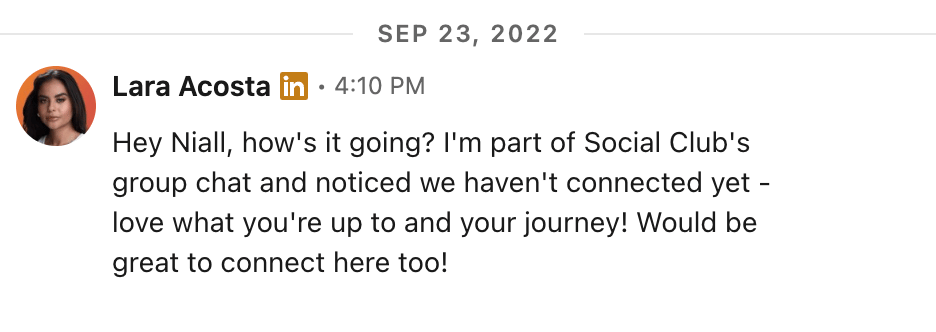
Today, Lara is one of the most followed people on the planet when it comes to LinkedIn marketing & personal branding with 100,000s of followers across multiple platforms. Recently, she’s been taking it up another notch, and I took some time to study why I think her online personality works so well. For me, it comes down to 2 things:
A) Conviction & Confidence
Lara gives off what I would call a ‘Boss bitch’ vybe - not sure that’s the technical marketing term for it ahaha. But every piece of content she puts out stinks of conviction and confidence.
Take a look at this video here.

It’s funny. It’s confident. There’s conviction in the tone. You may watch it and absolutely hate her, you may watch it and love her. But very few people will watch and feel nothing and that’s why it works. The best YouTubers on the planet, the best streamers on the planet, they all have distinct and visible personalities. The same applies to business and marketing content. Lara is the perfect example of someone who is blending traditional biz/marketing content with the style and personality of an influencer.
B) Aspirational Content
I could write a whole new essay on how big visual aesthetics have become in content nowadays. But if you just take 5 minutes to scroll Lara’s Instagram or LinkedIn you’ll start to see a clear visual aesthetic. She’s professional, but cool and her imagery is very aspirational.
People underestimate how important it is to look a certain way that your audience will admire. Lara gets this.
I’m not sure I have the pazazz that Lara possesses, but I think I can get much closer to it. People really underestimate the impact of looking aspirational.
Honorable Mentions
It’s 23:50 as I type this line, but I’m feeling like just reviewing these 3 individual people doesn’t make this essay valuable enough. So I want to do some honourable mentions of types of content I love and I’m going to lean into next year…
“Lesson I learned from [PERSON]” content
Sometimes the best thing you can do is just share lessons you learn from people 10 steps ahead of you. All of my best lessons are ones someone way ahead of me taught me. You get to add way more value and you gain a lot from pure association.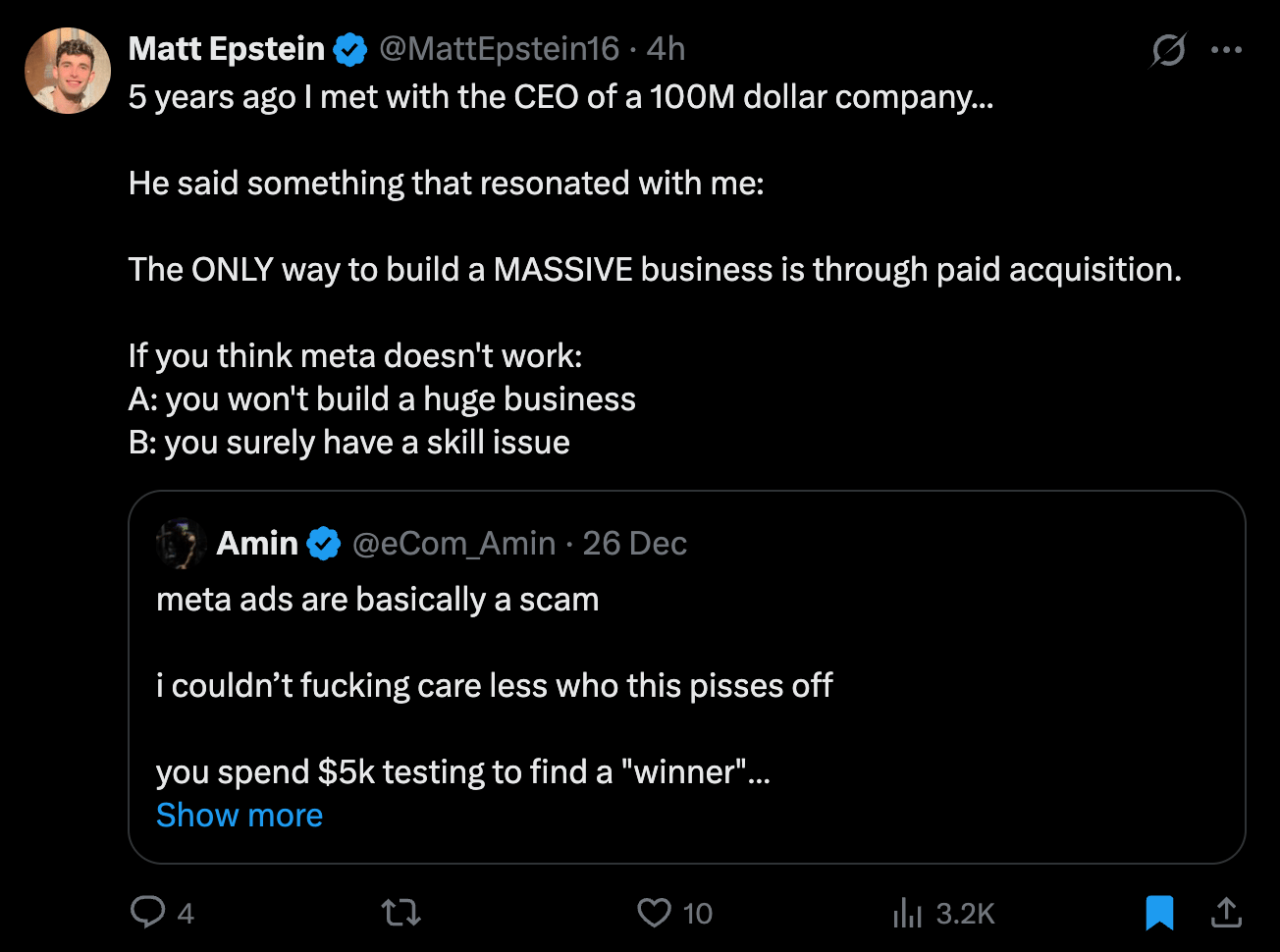
Shortcut content
One of the simplest pieces of content I love is when someone does something that I want to do but would take me a lot of time and gives me a shortcut to learning from it.
If you’ve spent 100s of hours doing anything, just explain what you learned from it and write about it.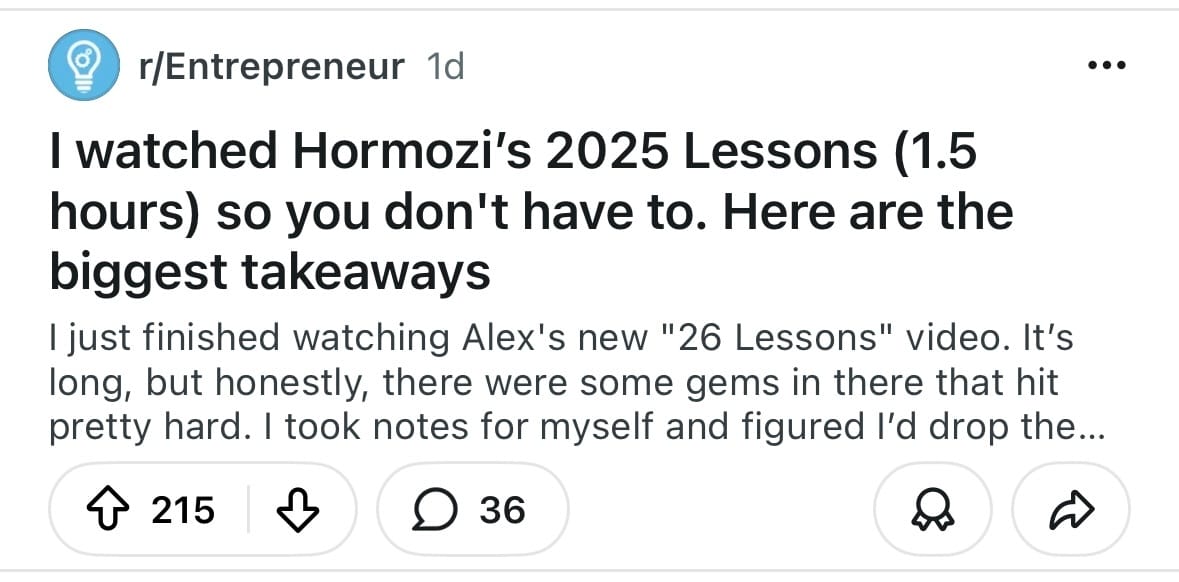
Okay, it’s midnight now, time for me to go to bed.
This one felt like a mini little content research session that I took you along for the ride on. Highly recommend you go and check out some of Harry Dry’s stuff after reading this. It’s great.
Right, that’s all for 2025. Thanks again for coming along for the ride. Cannot wait for you to see the level up in content for 2026.
See you in the new year!
Until next Sunday.
— Niall
WAIT… BEFORE YOU GO
Rate this week's essay! Was it good? Did you hate it? |
BROUGHT TO YOU BY
Banish bad ads for good
Google AdSense's Auto ads lets you designate ad-free zones, giving you full control over your site’s layout and ensuring a seamless experience for your visitors. You decide what matters to your users and maintain your site's aesthetic. Google AdSense helps you balance earning with user experience, making it the better way to earn.